
Forget tariffs: The real China-U.S. war is a battle for tech's soul
How the tech cold war is forging a world of competing standards
By TATIANA USAKOVA
Global Business Journalism reporter
Huang Shan, director and senior fellow at Caixin Insight, said that America and China are creating incompatible tech ecosystems, from AI to EVs. The winner will set the rules for the 21st century.
During a visit to the Tsinghua University campus on November 10, Huang urged students in the Global Business Journalism program’s "Hot Topics in the Global Economy" course to forget the trade wars. The real battle for the future, he said, is happening in the world of tech — and it is dividing the globe into two. In the corridors of power in Washington, Brussels and Beijing, a silent but seismic shift is underway. The new Great Game is not about tariffs or territory — it is about who controls the tech that will define the 21st century. The stakes could not be higher.
“The trade war is just a sideshow; the tech war is the main event,” Huang told the Tsinghua audience. “I
would not be surprised if the competition for next-generation technologies intensifies further.”
Huang Shan Huang Shan Huang Shan Huang Shan
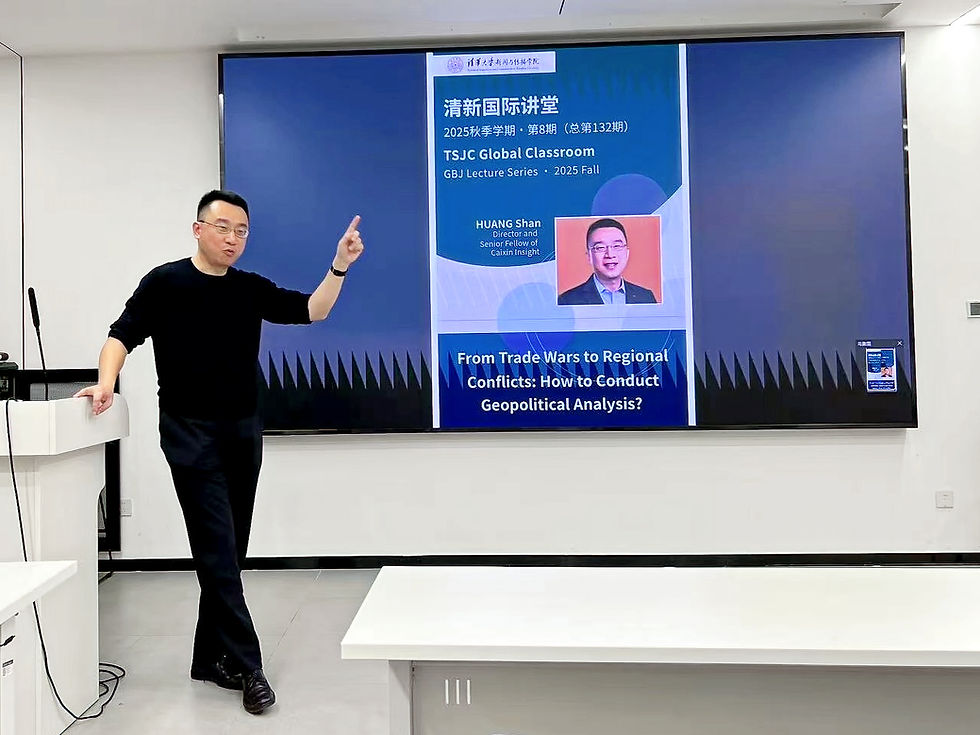
Huang Shan in action. (GBJ photos by Tatiana Usakova)
Huang explained what sparked the high-stakes tech standoff. In large part, it was China’s state-driven industrial policy, especially “Made in China 2025,” which he characterized as a stunning success. Beijing has systematically delivered on its promises, he argued, achieving global dominance in electric vehicles, renewables and drones, and making staggering leaps in quantum computing.
A decade ago, Western experts dismissed the plan as a bureaucratic fantasy and political talking points. The idea that a government could “pick winners” in tech was considered a fool's errand by many international business leaders accustomed to watching free markets work their will. They are not laughing anymore, he noted.
“Remarkably, China has achieved most of these goals in just 10 years, surprising the outside world,” Huang said.
Call it imitation — or call it survival. Under former President Joe Biden, the United States has rolled out the CHIPS and Science Act and the Inflation Reduction Act. President Donald Trump pressured Intel to give the U.S. government a 10% equity interest in the tech giant. The EU is boosting its own industrial
muscle. Everyone’s suddenly a believer in “industrial strategy,” the very model they once mocked.
As a result, countries are not heading toward a global village but toward a world of tech parallel universes following Chinese and non-Chinese models.
“In five years, for example, we will likely see “parallel universes” of technological standards,” Huang said. “Embracing China's commercial ecosystem means entering one parallel universe, while adhering to U.S. standards means entering another.”

He is convinced that the near future may look like a future where the apps on your phone, the charger for your EV, and the AI managing traffic are built on completely different, incompatible systems depending on whether you're in a country aligned with American or Chinese tech. This “balkanized” digital landscape is the direct cost of prioritizing national security over pure economic efficiency, he told the students.
“This is a very sad reality,” Huang said. “We are no longer pursuing the most efficient path to innovation. Instead, we are focused on national security and the safety of our technologies.”
Fundamentally different approaches to tech battle
The United States and China are not just competing; they are innovating in fundamentally different ways. America bets big on foundational research, the “0 to 1” breakthroughs. Fueled by venture capital and government grants for basic research, Washington focuses on foundational, “moonshot” breakthroughs. It's betting billions on the core architecture of AI and next-gen data centers.
China, meanwhile, masters the “1 to N” game — scaling tech at an unbelievable pace demonstrating a peerless ability to scale and apply existing technology. While America builds a better AI model, China deploys a thousand practical AI applications across factories, finance and cities. It is a grand, global experiment to see which model wins.

Huang said the biggest casualty of this tech cold war may be scientific progress itself. The golden age of global scientific collaboration is fading. Export controls, visa restrictions, and growing suspicion are replacing the free flow of ideas that once fueled breakthroughs in medicine, computing and more.
“We often say that science knows no borders,” Mr. Huang said. “But scientists do have nationalities.”
That reality is fueling Western skepticism of Chinese tech — from Huawei to TikTok — and pushing China to double down on self-reliance, racing to replace Western chips and software with homegrown alternatives.
The world is not just decoupling. It’s re-coupling — into rival tech spheres with competing standards. The dream of a united digital globe is over. The race for tech supremacy is on, and there is no finish line in sight — only two paths forward, leading to a divided tomorrow.


I tried diu win login game login but the page was taking time to load. Is this a common issue during busy hours, or does it depend on internet connection? If anyone knows, please reply.
I’m seeing diu win apk mentioned in a few places, so I wanted to check it out. Before using it regularly, can anyone confirm if it works properly on Android devices and whether it requires any verification
I’m having a small confusion with diuwin login game login. Does it require OTP verification every time, or only during the first login? Also, what should we do if OTP doesn’t arrive on time?
I was checking diu win register online and wanted to know if the experience is the same on browser and the app. Is there any difference in speed, result updates, or features between both options?
Vry useful information for anyone trying the diuwin login apk process for the first time. The instructions are easy to follow.